GWM Tank 500 2026 Review: HEV vs PHEV, Fuel Average & Verdict
GWM Tank 500 2026 review in Pakistan. Compare HEV and PHEV prices, real-world fuel average, electric range, comfort, off-road performance and resale.
By the Charkha team. 25 Nov 2026. 9 min read.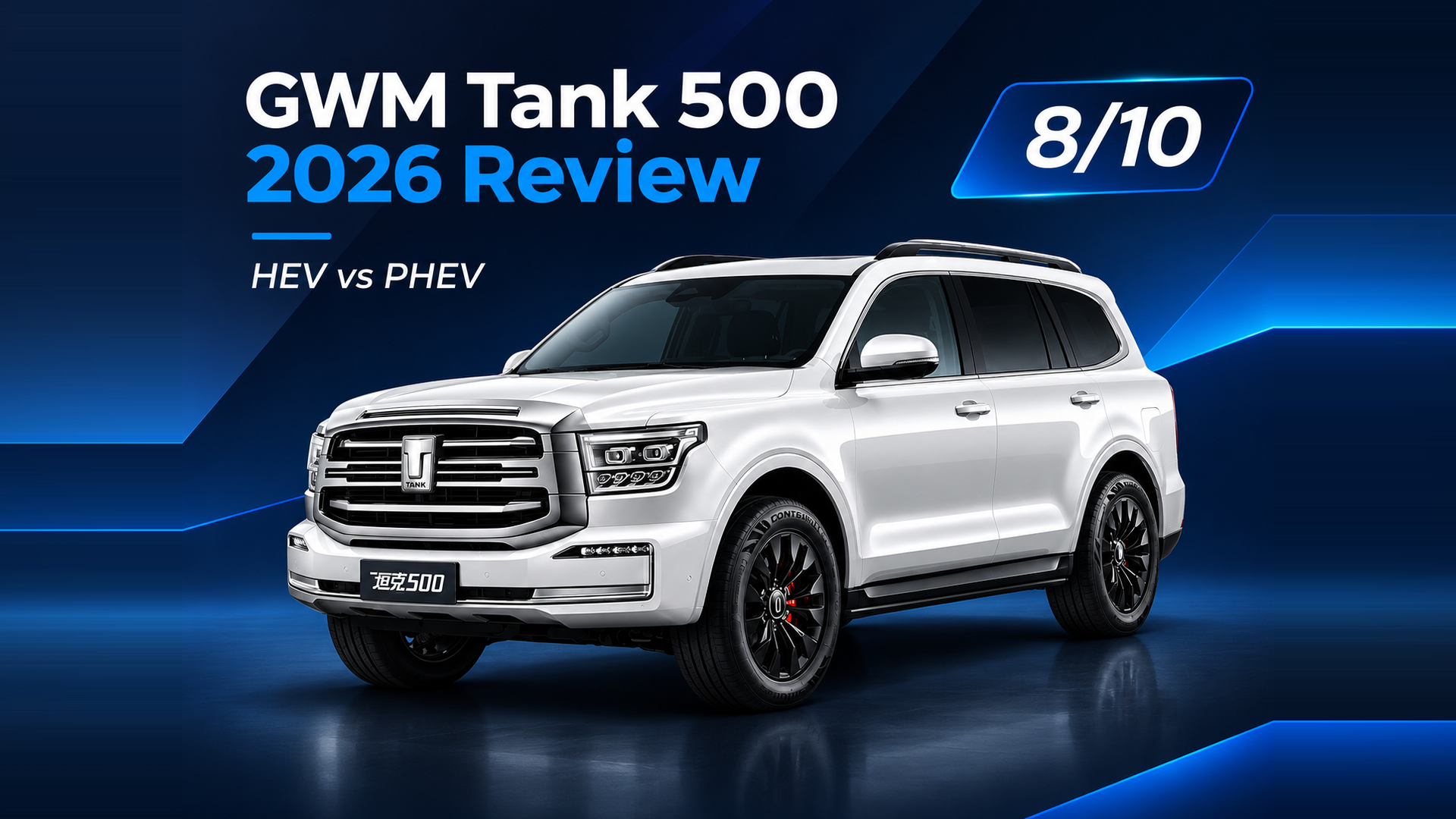
The GWM Tank 500 2026 is one of Pakistan's most talked-about luxury SUVs. Locally assembled by Sazgar, it combines imposing body-on-frame construction, a lavish interior and genuine four-wheel-drive hardware at prices that overlap with the Toyota Fortuner rather than a brand-new Land Cruiser. But the initial excitement has been followed by difficult questions about fuel economy, depreciation and reliability.
This GWM Tank 500 2026 review compares the seven-seat HEV with the five-seat PHEV, examining price, fuel average, charging, comfort, off-road ability and ownership costs in Pakistan.
Overview
Great Wall Motor's Tank brand specialises in luxury-oriented off-road SUVs. The Tank 500 uses a ladder-frame chassis, unlike comfort-first unibody crossovers, and offers low-range four-wheel drive and differential-locking equipment.
Pakistan's locally assembled Tank 500 range was introduced in January 2026. The HEV seats seven without external charging; the PHEV seats five with plug-in charging.
GWM Tank 500 2026 Price & Variants in Pakistan
The GWM Tank 500 2026 price in Pakistan is PKR 20,500,000 for the HEV and PKR 22,500,000 for the PHEV, ex-factory. The PKR 2 million difference comes before registration, applicable taxes, freight and insurance. Final on-road costs vary by registration city and tax status.
SpecificationTank 500 HEVTank 500 PHEVEx-factory pricePKR 20.5 millionPKR 22.5 millionSeating capacity7 seats5 seatsEngine2.0L turbo hybrid2.0L turbo plug-in hybridCombined power / torqueApprox. 342 hp / 648 NmApprox. 402 hp / 750 NmTransmission9-speed automatic9-speed automaticExternal chargingNoYesSeating layoutThree rowsTwo rowsOff-road drivetrain4WD with low range4WD with low range
Power and torque figures can differ slightly depending on the measurement standard used. The important distinction is that the PHEV delivers more combined output and electric-only driving capability, whereas the HEV prioritises seven-seat practicality. Confirm the precise equipment and current price through the official GWM Tank 500 page.
Exterior Design & Build Quality
The Tank 500 makes a strong first impression. Its huge chrome grille, rectangular LED headlights, squared body, wide wheel arches and tailgate-mounted spare wheel evoke traditional luxury off-roaders. At approximately 5,078 mm long, 1,934 mm wide and 1,905 mm tall, it has genuine road presence.
The chrome-heavy styling divides opinion, although it gives the Tank 500 a traditional luxury-SUV character. The visibly large gap between the tyres and wheel arches also divides opinion, despite the substantial wheel size.
Electrically deploying side steps make climbing into the high cabin easier. The spare tyre sits on the rear door, and the side-opening tailgate needs clearance behind the vehicle when parking.
Interior, Comfort & Practicality
Cabin comfort is where the Tank 500 justifies much of its price. Soft upholstery, decorative wood-style trim, ambient lighting and extensive seat adjustment deliver a genuinely luxurious atmosphere. Compared with a firmer Toyota Fortuner or an older Prado, the Tank 500's ride feels noticeably more relaxed and better insulated.
Front occupants benefit from supportive electrically adjustable seats, with heating, ventilation and massage functions on suitably equipped models. The second row provides generous legroom and a comfortable seating position, making the Tank 500 suitable for family motorway trips or chauffeur-driven use.
Seven-seat HEV versus five-seat PHEV
The HEV's third row is its main practicality advantage. It is suitable for children and occasional adult journeys, though second-row positioning affects legroom.
The PHEV trades those extra seats for a larger traction battery and five-seat configuration. Its second row has a lounge-like character, with additional comfort and control features, including rear-seat massage functions and a dedicated rear control screen.
Engine, Performance & Driving Experience
Both Pakistani versions combine a turbocharged 2.0-litre petrol engine with an electric motor and a nine-speed automatic transmission. The HEV produces approximately 342 hp and 648 Nm of combined output; the PHEV produces approximately 402 hp and 750 Nm. Both provide substantially more low-speed response than their engine displacement might suggest.
Despite its substantial weight, the Tank 500 does not feel underpowered in ordinary driving. Electric torque helps it accelerate confidently from low speed, while Sport mode sharpens the throttle response. The HEV's strong initial pull is a positive, even if fuel economy is less impressive than the hybrid badge might suggest.
The suspension is another highlight. The Tank 500 remains comfortable over uneven roads and feels considerably less abrupt over bumps than a typical Fortuner. Good road and wind insulation also contribute to its refined motorway character.
Nevertheless, it remains a heavy, tall SUV. Expect body movement and extra care in tight streets. The petrol engine can also become more prominent when accelerating hard or when the hybrid battery has limited charge.
Tank 500 HEV Fuel Average & PHEV Running Costs
GWM Tank 500 fuel average in Pakistan needs a realistic assessment. The HEV can return below 6 km/l in slow, short city driving, despite the possibility of approximately 9–10 km/l in more favourable use. Its small hybrid battery assists acceleration and low-speed movement but cannot sustain long periods of electric-only driving.
Neither extreme should be treated as a guaranteed result. Journey length, traffic, battery charge, air-conditioning, driving mode and road conditions can change consumption substantially. Buyers covering high monthly mileage should budget conservatively and measure consumption over several tank-to-tank refills.
Tank 500 PHEV electric range and charging
The PHEV uses a battery of approximately 37.11 kWh and offers up to 102 km of claimed electric-only range (WLTP). Under favourable everyday conditions, around 95–100 km per charge may be achievable with air conditioning, although motorway speeds, climate control and battery condition can reduce that figure.
The PHEV can be charged at home with a suitable installation, including a 7 kW wall charger. Overnight charging allows many city journeys to be completed largely on electric power, provided the vehicle is plugged in regularly.
At cruising speeds around 110–120 km/h, fuel economy near 13 km/l can be achievable when starting with a charged battery. That figure alone does not represent total journey energy cost: the electricity used to charge the battery must also be counted. Once the battery's usable charge is depleted, petrol consumption can increase.
Features & Technology
The Tank 500 offers an unusually generous equipment package. Highlights include a large central touchscreen, digital instrument panel, head-up display, panoramic sunroof, surround-view cameras, wireless phone connectivity, powered steering adjustment, ambient lighting and front massage seating.
The PHEV adds features aimed at second-row comfort, including a rear control screen and massage functions in the rear seats. Its larger battery also allows dedicated EV driving, a major functional difference from the HEV.
The 360-degree camera system and underbody-style transparent-chassis view are genuinely useful given the vehicle's size. Physical climate shortcuts help reduce reliance on touchscreen menus, although the many settings can take time to learn.
Not every convenience is perfect. The wireless charging pad may charge some phones slowly or cause noticeable heat, and frequent driver-assistance warning tones can interrupt audio playback. It is worth checking the controls and alert behaviour during a proper test drive.
Safety & Braking
The local Tank 500 is listed with six airbags and an extensive selection of electronic driving aids, including stability control, adaptive cruise control, lane assistance, blind-spot monitoring, forward collision warnings and automatic emergency braking.
Parking sensors and surround cameras are valuable for identifying motorcycles, low obstacles and pedestrians. The high bonnet and thick pillars still create blind spots.
Automatic-braking interventions and frequent warning tones can feel excessive in Pakistan's unpredictable traffic, especially where motorcycles pass closely or lane markings are inconsistent. Drivers should learn how the assistance systems behave and should not disable essential safety features solely to eliminate alerts.
Independent crash-test ratings from other markets should not be assumed to apply unchanged to the locally assembled specification.
Maintenance, Parts & Ownership Costs
Local assembly by Sazgar offers an important after-sales advantage over an independently imported luxury SUV. However, the Tank 500 is mechanically and electronically complex, combining turbocharging, hybrid equipment, 4WD hardware and numerous sensors.
Routine servicing involves engine oil, filters, braking-system inspections and hybrid-system checks. A basic oil-and-filter service may cost around PKR 20,000, but actual invoices depend on the dealership, mileage and work required. Major lighting units, cameras and specialist hybrid components may cost substantially more.
Before purchasing, request a written maintenance schedule, detailed parts quotations and the correct warranty booklet for the specific variant. The official GWM Pakistan warranty page provides further information. HEV and PHEV battery and electric-component terms should be checked individually.
Comprehensive insurance is strongly advisable. Headlights, cameras, body panels and hybrid components may be expensive to replace even when routine service costs seem manageable.
Competitors & Alternatives
The most obvious rival is the Toyota Fortuner. Its familiar mechanical layout, established service market and stronger resale history remain attractive. The Tank 500 counters with much more luxury equipment, greater cabin refinement and a noticeably softer ride.
The Toyota Prado delivers a long-established off-road reputation, but a similarly priced used example may be much older and less feature-rich. Buyers choosing between a brand-new Tank and used Prado must also assess previous maintenance and condition.
The Hyundai Palisade is worth considering for family travel on paved roads. Its unibody layout prioritises passenger comfort and seating flexibility, whereas the Tank 500 provides more traditional off-road hardware. Explore more SUV reviews on Charkha to compare the two approaches.
Resale Value & Market Perception
Resale remains one of the Tank 500's biggest uncertainties. Early used-market prices may fall as more vehicles enter circulation and initial launch excitement fades. Future depreciation will depend on local demand, variant, mileage, warranty coverage, taxes and the price of new units.
There is not yet enough transaction history to predict a dependable depreciation percentage. An asking price is not necessarily the price a car sells for. The Tank 500 makes more sense as a long-term vehicle to enjoy than as an asset expected to appreciate.
Final Verdict
The GWM Tank 500 2026 offers something uncommon in Pakistan: a genuinely capable luxury 4WD with lavish equipment and imposing road presence at a fraction of the price of a new Land Cruiser. Its comfort and performance are compelling, but the hybrid badge should not be mistaken for a promise of excellent fuel economy.
Choose the HEV if seven seats are essential and charging is impractical, while budgeting conservatively for petrol. Choose the PHEV if five seats are sufficient, you can charge reliably at home and want stronger performance with useful electric-only commuting.
For buyers prioritising resale predictability or the longest possible reliability record, Toyota remains worth considering. For those prioritising luxury, comfort and equipment while accepting some ownership uncertainty, the Tank 500 deserves a serious test drive.
Frequently Asked Questions
What is the GWM Tank 500 2026 price in Pakistan? The HEV is priced at PKR 20.5 million and the PHEV at PKR 22.5 million ex-factory, before registration and other on-road costs.
What is the Tank 500 HEV fuel average? Fuel consumption can fall below 6 km/l in heavy urban use, while around 9–10 km/l may be possible under more favourable conditions. There is no guaranteed average.
What is the Tank 500 PHEV electric range? Its claimed WLTP electric range is up to 102 km. Approximately 95–100 km may be possible in suitable conditions, but actual results depend on driving and climate control.
Is the Tank 500 a seven-seater? The HEV seats seven. The locally assembled PHEV seats five.
Does the Tank 500 have proper 4x4 capability? Yes. Its body-on-frame construction, low-range gearing and differential-locking features give it genuine off-road ability, although tyre choice and driver skill remain important.
Our verdict
8 / 10The GWM Tank 500 delivers impressive luxury, comfort, technology and genuine off-road capability for its price. The PHEV is the more compelling choice for buyers with home charging, while the HEV suits those needing seven seats. However, disappointing HEV fuel economy, depreciation and uncertain lon
- Luxurious interior with premium materials and excellent seating comfort
- Powerful turbo-hybrid performance, especially in PHEV form
- Advanced safety equipment, surround cameras and driver assistance
- Genuine off-road capability with 4WD, low-range gearing and differential locks
- PHEV offers substantial electric-only driving for daily commuting
- Seven-seat practicality in the HEV
- Poor HEV city fuel economy reported by some owners
- Early depreciation and uncertain long-term resale demand
- PHEV loses the third-row seats
- Large exterior dimensions make city manoeuvring challenging
- Overly sensitive ADAS warnings and occasional harsh interventions
- - Long-term reliability remains less established than Toyota's alternatives
- GWM Tank 500
- Tank 500 2026
- Tank 500 Pakistan
- Tank 500 Review
- Tank 500 HEV
- Tank 500 PHEV
- Tank 500 Price Pakistan
- Tank 500 Fuel Average
- Tank 500 Electric Range
- Tank 500 vs Prado
- Tank 500 vs Fortuner
- Hybrid SUV Pakistan