Honda Civic 2026 Review in Pakistan: Price, Fuel Average, Features & Verdict
Honda Civic 2026 review in Pakistan: explore prices, performance, features, fuel economy, and how it compares with SUVs, Corolla and Elantra Hybrid.
By the Charkha team. 13 Nov 2026. 14 min read.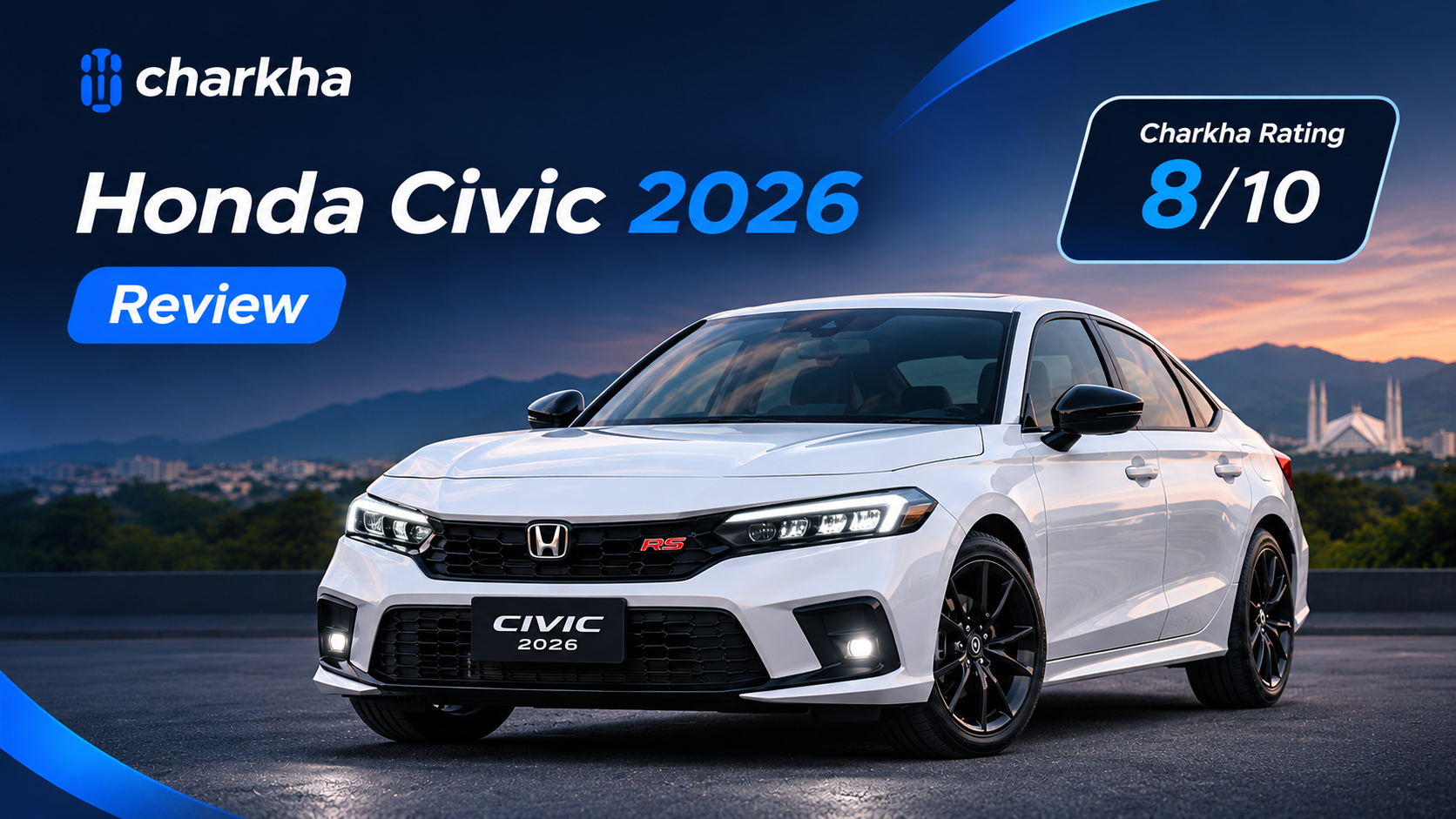
Overview
The Honda Civic has long been one of Pakistan's most desirable sedans, particularly among buyers who appreciate sporty styling, responsive performance, and a premium driving experience. The eleventh-generation Civic builds on that reputation with a more sophisticated design, improved cabin quality, and a refined turbocharged engine.
Introduced locally in 2022, the eleventh-generation Civic represented a noticeable departure from its predecessor. Instead of the aggressive styling of the tenth generation, Honda adopted a more mature appearance while retaining the Civic's sporty character. The 2026 facelift adds refreshed exterior details and makes Honda SENSING available across the lineup.
But the biggest challenge facing the Honda Civic today isn't another sedan. It's the growing number of SUVs and crossovers available at similar prices.
With buyers spending approximately Rs. 8.5 million to Rs. 10.1 million, their options extend beyond traditional sedans. Several manufacturers offer stylish crossovers with higher ground clearance, spacious interiors, and competitive technology.
The Civic still has its strengths. Its premium cabin, balanced driving characteristics, and particularly the RS variant's turbocharged performance make it attractive to enthusiasts.
However, whether those qualities justify its price depends on what a buyer values most.
Price & Variants in Pakistan
The Honda Civic 2026 is listed in three variants in Pakistan.
Honda Civic 2026 Prices
- Honda Civic Standard: Rs. 8,499,000
- Honda Civic Oriel: Rs. 8,834,000
- Honda Civic RS: Rs. 10,100,000
Prices checked in November 2026. These are ex-factory prices and exclude registration, applicable taxes, insurance, and other on-road costs. Confirm Standard variant availability before booking.
Honda Civic Standard
The Standard provides the fundamental Civic experience, including a turbocharged 1.5-litre engine, CVT transmission, dual-zone climate control, and Honda SENSING.
It is suitable for buyers who want the Civic's design and driving characteristics without paying for additional luxury equipment.
Honda Civic Oriel
The Oriel adds convenience and comfort features, including a sunroof and upgraded infotainment equipment.
With a relatively small price difference compared with the Standard, it presents an appealing balance between features and cost.
Honda Civic RS
The RS is the performance-oriented flagship, producing considerably more power and torque than the other two variants.
It also features sportier styling, 17-inch alloy wheels, premium cabin finishes, and additional technology.
Our recommendation: The Oriel makes the most financial sense for everyday use, while the RS is the variant that best represents the Civic's sporty personality.
For a detailed breakdown, visit the Honda Civic price and specifications page on Charkha.
Exterior Design & Build Quality
The eleventh-generation Honda Civic has a mature yet athletic appearance.
Its long bonnet, low roofline, wide stance, and clean character lines create an elegant profile. Compared with the previous generation, the design is less aggressive but arguably more sophisticated.
The 2026 facelift introduces revised front-end styling, including an updated grille that gives the Civic a refreshed appearance.
The RS stands out with matte-black 17-inch alloy wheels, black exterior accents, a rear spoiler, and dual exhaust outlets.
LED headlights and additional styling elements further distinguish the flagship from the lower variants.
The Civic measures approximately 4,695 mm in length, 1,802 mm in width, and 1,432 mm in height. Its 2,735 mm wheelbase contributes to its long, balanced proportions.
However, one practical concern is its 154 mm ground clearance.
Although suitable for regular paved roads, the Civic requires more attention around unusually large speed breakers, steep ramps, and damaged roads.
This becomes particularly relevant when comparing it with similarly priced crossovers.
The Civic looks elegant and sporty, but a higher-riding vehicle may be more convenient for buyers regularly travelling on uneven roads.
Interior, Comfort & Practicality
The interior is one of the strongest reasons to consider the eleventh-generation Civic.
Honda moved away from the more complicated dashboard design of the previous generation and introduced a cleaner, horizontal layout.
The honeycomb-style air vents are particularly distinctive, giving the dashboard a modern appearance without making it feel unnecessarily busy.
The cabin combines practical controls, comfortable seating, and a driver-focused layout.
The RS adds darker interior finishes, contrasting stitching, and sportier detailing, helping create a more premium atmosphere.
Seating & Comfort
The Civic provides generous front-seat space, an adjustable driving position, and good accommodation for rear passengers.
Its long wheelbase offers respectable rear legroom, making it suitable for everyday family use.
Rear air-conditioning vents, a folding armrest, and storage compartments improve practicality.
The Civic is officially a five-seater, although four adults will generally enjoy greater comfort during longer journeys.
The approximately 409-litre boot offers useful luggage space for shopping, airport trips, and family travel.
Cabin refinement is another appealing aspect. The design feels more sophisticated than that of many entry-level sedans, although certain interior surfaces still use conventional hard plastics.
The Civic's cabin feels like a meaningful upgrade over more economical sedans, particularly for buyers who appreciate design, seating comfort, and a driver-oriented environment.
However, buyers prioritizing maximum cabin flexibility, a higher seating position, or easier entry and exit may prefer a crossover.
Engine, Performance & Driving Experience
The Honda Civic 2026 uses a 1,498cc four-cylinder turbocharged petrol engine paired with a CVT.
Despite sharing the same displacement, the engine produces different outputs depending on the variant.
Standard & Oriel
- Maximum power: Approximately 127 hp
- Maximum torque: 180 Nm
- Transmission: CVT
- Drivetrain: Front-wheel drive
RS
- Maximum power: Approximately 176 hp
- Maximum torque: 220 Nm
- Transmission: LL-CVT
- Drivetrain: Front-wheel drive
The RS offers a significant performance advantage, particularly during acceleration and overtaking.
Driving Character
The Civic's appeal extends beyond horsepower figures.
Its relatively low centre of gravity, independent rear suspension, and carefully balanced chassis give it a more driver-focused character than many taller family crossovers.
The steering and suspension are designed to provide a balance between comfort and handling.
The CVT contributes to smooth everyday acceleration, although drivers who prefer conventional gear changes may find its behaviour less engaging during harder acceleration.
The RS adds paddle shifters and selectable driving modes, giving enthusiasts greater involvement.
Independent driving reviews of the eleventh-generation RS have highlighted its composed handling, comfortable seating, and confidence on winding roads.
However, these observations should not be interpreted as results from a Charkha road test.
City vs Highway
For city commuting, the Civic offers convenient automatic driving and a comfortable cabin.
On highways, its long wheelbase and relatively low body contribute to a planted driving character.
The RS is particularly appealing to buyers who want stronger overtaking performance.
However, turbocharged performance and sporty handling come with trade-offs, including increased fuel consumption during aggressive driving and greater sensitivity to road conditions.
For buyers who genuinely enjoy driving, the Civic RS remains one of the more appealing locally assembled sedans.
Fuel Economy & Running Costs
The Civic's fuel consumption is reasonable for a turbocharged sedan, although economy is not its strongest selling point.
Commonly published estimates place its fuel consumption around 11–14 km/l, depending on driving conditions and variant.
In congested city traffic, particularly with air conditioning running, actual consumption can be lower.
Highway driving at consistent speeds generally delivers better efficiency.
The Civic has a 47-litre fuel tank.
A buyer travelling 1,000 kilometres monthly at an average of 11 km/l would consume approximately 91 litres of petrol.
However, fuel is only one component of ownership costs.
Routine servicing, suitable engine oil, CVT maintenance, tyres, and potential turbocharger-related repairs must also be considered.
The RS may become more expensive to operate when driven aggressively.
This is an area where the Hyundai Elantra Hybrid becomes particularly relevant.
For buyers covering significant daily distances, hybrid technology can offer a meaningful fuel-economy advantage, potentially offsetting part of its higher purchase price over time.
The Civic remains suitable for daily commuting, but buyers prioritizing minimum fuel expenses should evaluate their alternatives carefully.
Features & Technology
The Honda Civic 2026 offers a useful combination of convenience and technology, although equipment varies by variant.
Key Features
Depending on the selected variant, available equipment includes:
- Digital driver-information display
- Touchscreen infotainment
- Dual-zone automatic climate control
- Push-button engine start
- Rear air-conditioning vents
- Steering-mounted controls
- Rear-view camera
- Rain-sensing windshield wipers
- Sunroof
- Wireless charging
- Electronic parking brake
- Automatic brake hold
The Oriel adds several comfort features that enhance everyday ownership.
The RS offers additional equipment, including a 9-inch Android-based infotainment system, wireless charging, premium upholstery, an auto-dimming rear-view mirror, and key-related convenience features.
The instrument display provides information such as driving range, fuel consumption, and vehicle settings.
However, at this price, buyers may expect more sophisticated infotainment integration and a broader selection of premium conveniences.
Some competing crossovers offer larger displays, additional cameras, powered seats, and other equipment depending on the variant.
Technology should also be judged by usability rather than screen size alone.
The Civic's physical climate controls and relatively straightforward dashboard are welcome features for drivers who prefer simple operation.
For the latest equipment details, buyers can explore the official Honda Civic RS specifications.
Safety
Safety is an important consideration, particularly for a vehicle occupying the premium end of Pakistan's locally assembled sedan market.
The 2026 Civic facelift introduces a meaningful improvement by making Honda SENSING available across all three variants.
Honda SENSING
This driver-assistance package includes technologies such as:
- Collision Mitigation Braking System
- Adaptive Cruise Control
- Lane Keeping Assist System
- Road Departure Mitigation System
- Auto High Beam
- Lead Car Departure Notification
These features can assist during everyday driving, particularly on well-marked highways.
However, driver-assistance technology is not a substitute for attentive driving, and system performance depends on road conditions, visibility, and other factors.
The Civic also includes safety equipment such as ABS, electronic brake-force distribution, vehicle stability assistance, and ISOFIX child-seat anchors.
One disappointing aspect is the reported provision of only two front airbags in Pakistan-market variants.
For a vehicle costing up to Rs. 10.1 million, buyers may reasonably expect more comprehensive passive safety equipment.
The availability of Honda SENSING is welcome, but it does not eliminate the importance of structural protection and adequate airbags.
International Civic crash-test results should not automatically be applied to locally assembled models without confirming matching specifications.
Overall, the Civic offers useful active-safety technology, but there is room for improvement in passive safety equipment.
Maintenance, Reliability & Resale Value
The Civic benefits from Honda's established presence in Pakistan.
Authorized workshops, parts suppliers, and experienced mechanics make ownership more convenient than it might be for some newer entrants.
However, maintenance costs can be relatively high.
Its turbocharged engine, CVT, electronic systems, and premium components require proper servicing.
Owners should follow Honda's oil, fuel, and transmission maintenance recommendations rather than attempting to reduce costs through unsuitable products.
Earlier generations of the turbocharged Civic experienced reported fuel-related knocking concerns, although Honda subsequently introduced improvements.
These historical concerns should not automatically be treated as defects in the 2026 model.
Civic vs Corolla Ownership Costs
The Toyota Corolla offers a different ownership proposition.
Its naturally aspirated engines are mechanically simpler than the Civic's turbocharged setup, and Toyota has a particularly well-established service and parts ecosystem throughout Pakistan.
The Corolla also benefits from a strong reputation for durability, predictable maintenance, and resale demand.
The Civic has its own loyal customer base and established resale market, but its premium components may increase repair expenses.
The Corolla is generally the more cost-conscious choice, while the Civic offers a more premium and performance-oriented experience.
Neither car is maintenance-free, and actual reliability depends on servicing, driving habits, and vehicle condition.
For buyers planning long-term ownership, this difference deserves serious consideration.
Competitors & Alternatives
Competition is arguably the biggest challenge facing the Honda Civic 2026.
At its current price, the Civic must compete not only against sedans but also against modern crossovers and SUVs.
Toyota Corolla Altis Grande
The Corolla remains one of the most practical alternatives.
It offers a lower purchase price, an established resale market, and a simpler naturally aspirated engine.
The Corolla particularly appeals to buyers prioritizing reliability, affordable maintenance, and everyday usability.
The Civic, on the other hand, offers a more sophisticated interior, modern styling, and stronger performance in the RS variant.
Choose the Corolla for practicality and cost-conscious ownership. Choose the Civic for a more premium and sporty driving experience.
Hyundai Elantra Hybrid
The Hyundai Elantra Hybrid is one of the Civic's most interesting competitors.
Its sharp styling, modern cabin, hybrid powertrain, and technology make it a genuine alternative to the Civic RS.
The Elantra particularly appeals to buyers who want a premium sedan while placing greater importance on fuel efficiency.
The Civic RS offers a different driving character, with a turbocharged engine and a sportier performance-oriented identity.
Both vehicles have appealing interiors, but their strengths differ.
Buyers choosing between them should compare fuel costs, driving preferences, warranty coverage, long-term maintenance, and equipment rather than focusing on horsepower alone.
Modern SUVs & Crossovers
This is where the Civic faces its biggest challenge.
At approximately Rs. 8.5–10.1 million, Pakistani buyers can consider vehicles such as:
- Haval Jolion: A modern crossover with distinctive styling, a higher seating position, and available hybrid technology.
- Changan Oshan X7: A spacious crossover offering strong road presence and available seven-seat configurations.
- Toyota Corolla Cross: A practical crossover with Toyota's established ownership ecosystem and available hybrid variants.
- Kia Sportage L: A modern crossover that emphasizes interior space, comfort, and a more commanding driving position.
- MG HS: A feature-focused crossover with a modern interior and SUV-style practicality.
These options offer something the Civic cannot easily match: a higher seating position, increased ground clearance, and a different style of family usability.
For buyers frequently travelling on damaged roads or navigating large speed breakers, these advantages matter.
Some crossovers also offer panoramic roofs, larger displays, extensive camera systems, and other premium features.
However, a crossover is not automatically better than a sedan.
Its taller body, greater weight, and different suspension tuning can affect handling, driving involvement, and fuel consumption.
The Civic's lower centre of gravity and sporty chassis remain attractive for buyers who prioritize road handling and driver engagement.
Ultimately, the choice depends on priorities.
If you want road presence, ground clearance, and SUV practicality, several crossovers deserve consideration. If you want a premium sedan with a sporty driving character, the Civic remains relevant.
Final Verdict: Should You Buy It?
The Honda Civic 2026 is a well-rounded sedan with a premium interior, attractive styling, and a refined driving experience.
Its eleventh-generation platform offers an appealing balance of comfort and handling, while the RS provides particularly strong performance for enthusiasts.
The addition of Honda SENSING across the lineup is also a welcome improvement.
However, the Civic's price changes the buying decision significantly.
When spending close to Rs. 9–10 million, buyers have access to multiple SUVs, crossovers, and hybrid vehicles offering different advantages.
The Civic's low ground clearance, relatively high maintenance costs, and limited passive safety equipment are important considerations.
The Toyota Corolla is a more affordable and generally cost-conscious alternative, while the Hyundai Elantra Hybrid offers compelling competition through its design, equipment, and efficiency.
Which Civic Variant Should You Buy?
- Civic Standard: For buyers who want the core Civic experience at the lowest price.
- Civic Oriel: Our preferred overall choice for comfort, equipment, and value.
- Civic RS: For buyers who genuinely appreciate performance, sporty styling, and additional premium equipment.
Charkha's Verdict: The Civic remains one of Pakistan's most appealing premium sedans, particularly for buyers who value driving enjoyment. However, it is no longer the obvious choice at this price. Buyers should compare modern SUVs and hybrids before deciding whether the Civic's sporty character is worth the premium.
Frequently Asked Questions
1. What is the price of Honda Civic 2026 in Pakistan?
The Civic Standard is listed at Rs. 8,499,000, the Oriel at Rs. 8,834,000, and the RS at Rs. 10,100,000, excluding on-road expenses. Confirm Standard availability before booking.
2. Is the Civic RS worth the extra money?
The RS offers substantially more power, sportier styling, and additional equipment. It is worth considering for enthusiasts, but the Oriel offers better value for most everyday buyers.
3. Is the Honda Civic better than the Toyota Corolla?
The Civic offers a more premium cabin and a sportier driving experience, especially in RS form. The Corolla is generally more affordable and appeals to buyers prioritizing straightforward maintenance and ownership costs.
4. Honda Civic or Hyundai Elantra Hybrid: Which is better?
The Elantra Hybrid is compelling for buyers prioritizing fuel efficiency and modern hybrid technology. The Civic RS suits drivers who prefer turbocharged performance and sporty handling.
5. Should I buy a Civic or an SUV in Pakistan?
Choose the Civic if you value sedan handling, premium styling, and driving involvement. Consider a crossover if higher ground clearance, a commanding seating position, or additional family practicality matters more.
6. Does Honda Civic 2026 have Honda SENSING?
Yes. Honda SENSING is included across the 2026 Civic lineup, providing active driver-assistance features such as adaptive cruise control, collision mitigation braking, and lane-keeping assistance.
Our verdict
8 / 10The Honda Civic 2026 delivers a premium, sporty driving experience with a refined interior and impressive RS performance. However, with several modern SUVs and hybrids available at similar prices, it makes the most sense for buyers who specifically value the experience of driving a sedan.
- Premium and spacious interior
- Strong RS turbocharged performance
- Refined handling and modern safety technology
- Expensive compared with other sedans
- Low ground clearance
- Strong SUV and hybrid competition at this price
- Honda Civic
- Civic 2026
- Civic RS
- Civic Oriel
- Honda Pakistan
- Hyundai Elantra
- Toyota Corolla
- Sedans
- Car Reviews