Toyota Yaris 2026 Review: A Better-Looking Sedan, But Is It Worth the Price?
Toyota Yaris 2026 review in Pakistan. Explore its 1.3L and 1.5L performance, fuel average, comfort, features, safety and value before buying.
By the Charkha team. 14 Nov 2026. 15 min read.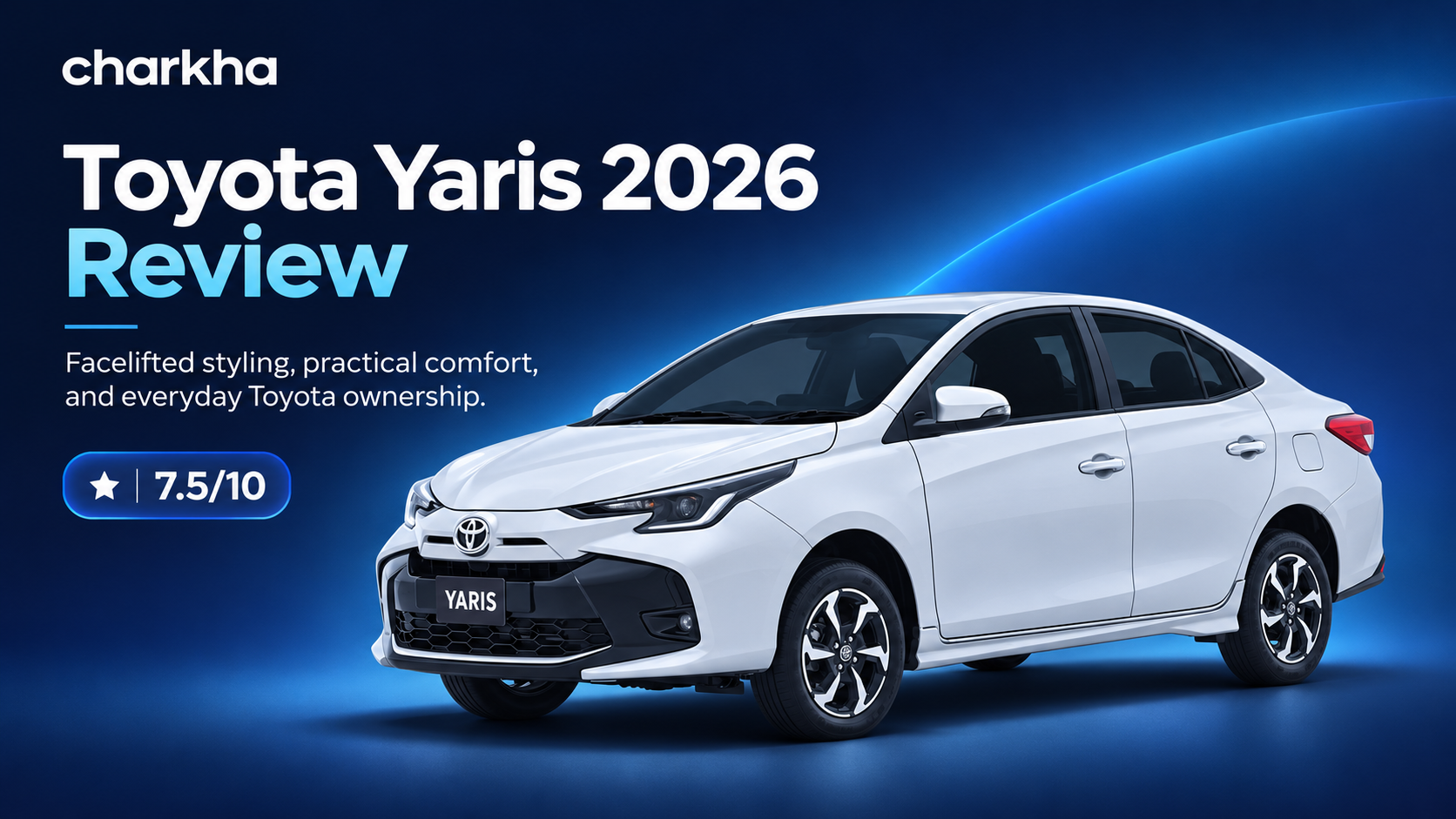
The Toyota Yaris has established itself as one of Pakistan's familiar compact sedans, appealing to buyers who want a comfortable daily driver without taking unnecessary risks on maintenance or long-term ownership. It competes primarily with the Honda City and Changan Alsvin, offering Toyota's reputation for reliability in a smaller, more city-friendly package.
For 2026, the Yaris continues with the facelift introduced in 2024. That update brought a significantly redesigned front end, improved equipment and some welcome safety additions. However, underneath the refreshed appearance, this remains largely the same Yaris that entered the Pakistani market in 2020.
So, has Toyota improved the Yaris enough to justify its price, or are buyers mostly paying extra for a more attractive version of an existing car? Let's examine its design, interior, performance, fuel economy, comfort and ownership value.
Exterior Design: A Much-Needed Transformation
Exterior styling was one of the biggest criticisms of the original Pakistani Yaris. Its rounded front end, relatively tall body and unusual headlight design gave it a rather awkward appearance. The facelift addresses many of those concerns.
Front Design
The most noticeable improvement is the completely redesigned front fascia. The bumper is more aggressive, the grille looks wider and the overall design gives the Yaris a stronger road presence.
On the higher-spec ATIV X, the updated projector LED headlights, integrated daytime running lights and LED fog lamps provide a considerably more modern appearance. The combination of gloss-black trim and body-coloured surfaces also makes the front look more cohesive.
Importantly, the new lighting arrangement is not just a cosmetic improvement. The LED setup offers better illumination than the older halogen arrangement, making it a useful upgrade for night driving.
Side Profile
Move to the side and the Yaris becomes much more familiar. Toyota has retained the original body structure, roofline and general proportions. This is a facelift rather than a new generation, so the underlying shape remains unchanged.
The updated alloy-wheel designs improve its appearance, while the factory-fitted side skirts on the higher variants help reduce the visually tall stance that previously made the car look less planted.
The higher variants also benefit from electrically retractable side mirrors. Lower trims, including the GLI reviewed in the supplied material, have electrically adjustable mirrors that require manual folding.
All variants use relatively modest 15-inch wheels, with 185/60 R15 tyres specified for the range. These suit the Yaris's comfort-focused character, although buyers expecting a particularly sporty stance may find them a little small.
Rear Design
The rear receives fewer changes than the front because the original design was already more balanced. Toyota has introduced revised bumper detailing and a darker diffuser-style treatment that makes the car look slightly lower and wider.
The upper variants also receive styling elements that complement the updated front end. The changes are noticeable without being excessive.
Overall, the facelift gives the Toyota Yaris a much stronger visual identity. It still isn't the sportiest sedan in its segment, but it looks significantly more contemporary than the pre-facelift model.
Interior: Practical but Fundamentally Unchanged
Inside, the improvements are less dramatic. While Toyota has refreshed the colours, upholstery and infotainment equipment, the basic dashboard architecture remains almost identical to the original Yaris.
That is not necessarily a problem for functionality. The dashboard is straightforward, the controls are generally easy to understand and the driving position offers good forward visibility.
However, the cabin does not feel particularly modern when compared with newer vehicles in a similar price bracket.
Dashboard and Material Quality
Hard plastics dominate the upper dashboard and several door surfaces. Toyota has used contrasting trims and stitched-effect panels to make the interior more attractive, but the overall material quality remains more functional than luxurious.
The facelifted ATIV X offers black and beige interior choices. The black interior gives the cabin a more contemporary appearance, while the beige option creates a brighter and more traditional family-sedan atmosphere.
The upper variant also benefits from a leather-wrapped steering wheel and upgraded seat upholstery. These small details improve the areas that occupants interact with most frequently.
Even so, the Yaris lacks some flexibility in its driving position. The steering wheel adjusts for tilt but not reach, which can make finding the ideal posture slightly more difficult for certain drivers.
Infotainment and Technology
One of the better improvements in the facelifted Yaris is its infotainment setup. The higher-specification ATIV X features a 9-inch floating touchscreen with Apple CarPlay and Android Auto connectivity.
Compared with the older integrated display, the larger screen looks more modern and is easier to use. The multimedia interface is responsive in the reviewed vehicle, with good display clarity and sound quality.
The instrument cluster retains its familiar layout, with an information display for fuel consumption, trip data and driving information. The updated graphics provide a fresher appearance, although the setup is still fairly conventional.
The ATIV X also includes automatic climate control, push-button start, a smart-entry system and steering-mounted controls. Cruise control is available on selected automatic variants, including the 1.3 ATIV CVT and 1.5 ATIV X CVT.
These features make the upper Yaris variants reasonably well equipped for everyday use, but buyers should check the exact specification of the version they intend to purchase. The entry-level GLI models offer a noticeably simpler cabin experience.
Cabin Space and Passenger Comfort
Passenger accommodation is one of the Yaris's more important strengths. Despite being a compact sedan, it provides a useful amount of interior space for a small family.
Front Seats
The front seats offer comfortable cushioning for routine commutes, and the upright seating position makes getting in and out relatively easy.
The softer seat character is well suited to urban driving. However, the seats do not provide exceptional under-thigh support, something that becomes more noticeable during very long journeys.
In one extended road test, the reviewer reported fatigue after several hundred kilometres of continuous travel. This does not make the Yaris uncomfortable, but it highlights the difference between a capable daily commuter and a more substantial long-distance touring sedan.
Rear Seat Space
The rear cabin offers decent legroom and headroom for the segment. A relatively flat floor also makes the centre seating position more usable than in cars with a large transmission tunnel.
Three adults can sit in the rear for shorter journeys, although shoulder room remains limited by the car's compact width. Two adults and a child will be a more comfortable arrangement for longer trips.
One welcome detail is the provision of three rear headrests, which is useful when carrying passengers in all three positions.
The biggest omission is the absence of dedicated rear AC vents. Rear passengers must rely on airflow from the front, which is less convenient during Pakistan's hotter months.
Toyota does provide rear power outlets, but their arrangement is less convenient than modern integrated USB charging ports.
Boot Space
The Toyota Yaris offers a 476-litre luggage compartment, making it practical for grocery runs, airport trips and family travel.
The boot opening is reasonably wide, and the luggage area can accommodate multiple bags without excessive difficulty. A spare wheel and tyre-changing equipment are positioned beneath the boot floor.
For buyers upgrading from a hatchback, this additional luggage capacity is a meaningful advantage.
Engine Specifications and Performance
The Pakistani Toyota Yaris continues to use two naturally aspirated petrol engines: a 1.3-litre unit and a 1.5-litre unit. Both are designed around smooth daily use and reasonable running costs rather than outright performance.
Specification1.3L Yaris1.5L YarisEngine displacement1,329 cc1,496 ccEngine code1NR-FE2NR-FEMaximum powerApproximately 98 hpApproximately 106 hpMaximum torque123 Nm140 NmEngine configuration4-cylinder, Dual VVT-i4-cylinder, Dual VVT-iTransmission5-speed manual or CVTCVT in the current ATIV X lineupDrivetrainFront-wheel driveFront-wheel drive
Toyota Yaris 1.3L Performance
The 1.3-litre engine produces approximately 98 horsepower and 123 Nm of torque. For regular city driving, this is sufficient for commuting, shopping trips and routine family use.
The CVT automatic transmission makes low-speed driving convenient, particularly in Karachi and Lahore traffic, where constant acceleration and braking can make a manual transmission tiring.
However, the smaller engine has its limitations. With multiple passengers, luggage or steep inclines, acceleration requires more patience. Overtaking at highway speeds can also require the engine to work harder.
For someone primarily driving within the city and prioritising economy over acceleration, the 1.3-litre Yaris remains a sensible option.
Toyota Yaris 1.5L Performance
The 1.5-litre ATIV X produces approximately 106 horsepower and 140 Nm of torque. Although these figures are not particularly impressive on paper, the additional torque makes the car feel more flexible than the 1.3-litre version.
In city traffic, the 1.5-litre engine provides adequate performance without feeling unnecessarily aggressive. Its acceleration is predictable, and the CVT delivers smooth progress under normal throttle inputs.
The engine becomes more vocal when accelerating hard or attempting a quick overtake. This is a familiar characteristic of conventional CVT-equipped cars, where engine speed can rise noticeably before road speed catches up.
The Yaris CVT is commonly described as a seven-speed transmission, but these are simulated ratios rather than seven conventional fixed gears.
Overall, performance is adequate rather than exciting. The 1.5-litre engine offers a useful improvement over the 1.3, but buyers looking for strong acceleration or a sporty driving experience may find the Yaris underwhelming.
Fuel Average: How Efficient Is the Toyota Yaris?
Fuel economy is one of the most important factors for Pakistani sedan buyers, and the Yaris generally performs reasonably well when driven smoothly.
However, actual mileage depends heavily on traffic conditions, air-conditioning use, driving speed, tyre pressure, vehicle load and maintenance.
Expected Fuel Consumption
VariantCity DrivingHighway DrivingYaris 1.3LApproximately 12–14 km/lApproximately 15–18 km/lYaris 1.5L CVTApproximately 11–14 km/lApproximately 13–16 km/l
These figures are indicative real-world ranges, not guaranteed results or official laboratory ratings.
One extended review of the facelifted 1.5-litre Yaris reported highway fuel consumption between approximately 11.3 and 13 km/l with air conditioning, depending on cruising speed. Higher motorway speeds reduced efficiency noticeably.
Another comparison placed the facelifted 1.5-litre Yaris against the Honda City 1.5 on a shared driving route. Over approximately 56.5 kilometres, the Yaris required about 3.82 litres of fuel, compared with 3.73 litres for the City.
That works out to approximately 14.8 km/l for the Yaris and 15.1 km/l for the City during that particular test. The small difference is not sufficient to establish that one vehicle will always be more economical.
These observations also show why dashboard fuel-economy readings should not always be treated as exact. Repeated tank-to-tank measurements provide a more useful picture of long-term consumption.
For the best mileage, moderate acceleration and steady cruising speeds matter more than simply choosing a particular transmission or engine size.
Ride Quality, Suspension and Handling
The Toyota Yaris is primarily engineered for comfort, and that is apparent in its suspension setup.
It uses MacPherson struts at the front and a torsion-beam arrangement at the rear. This conventional setup delivers a reasonable balance of cost, durability and everyday ride comfort.
City Driving
On typical Pakistani roads, the Yaris absorbs smaller bumps and uneven surfaces reasonably well. Its 175 mm ground clearance also helps when negotiating speed breakers, ramps and rough streets.
The steering is light at lower speeds, making parking and manoeuvring through tight traffic relatively easy. Combined with its compact dimensions, this gives the Yaris a user-friendly character.
The suspension is not exceptionally sophisticated, but it suits the type of driving most owners will encounter.
Highway Stability
Despite its relatively tall appearance, the Yaris feels reasonably secure during normal highway driving.
In the supplied road test, the 1.5-litre model was driven extensively between Lahore and Islamabad. The reviewer found its cornering grip reassuring at appropriate speeds, although the car remained noticeably comfort-oriented rather than sporty.
Passing heavy vehicles can produce a brief sensation of movement from air pressure, while wind and road noise become more noticeable at higher speeds.
Tyre condition and road surfaces also have an important influence on cabin noise and overall stability.
For most families, the suspension and handling balance is appropriate. Enthusiastic drivers, however, may prefer the more connected driving feel offered by some alternatives.
Safety Features: Useful Improvements, but Room for More
Safety equipment is one area where the facelifted Toyota Yaris brings meaningful improvements.
The current Pakistan-market range is advertised with three SRS airbags, covering the driver, front passenger and driver's knee. This improves upon the earlier two-airbag arrangement.
The Yaris also offers several important electronic safety systems, including:
Anti-lock Braking System (ABS)
Electronic Brake-force Distribution (EBD)
Brake Assist
Vehicle Stability Control (VSC)
Traction Control
Hill-start Assist Control
ISOFIX child-seat anchors
Rear parking sensors
A reversing camera is also available in the current range. However, the camera demonstrated in the higher-specification road test used static rather than steering-responsive parking guidelines.
These systems make the Yaris reassuring for everyday use, especially compared with older sedans that lacked modern electronic stability assistance.
Nevertheless, the Yaris does not offer the wider suite of advanced driver-assistance systems found in some newer vehicles. Features such as autonomous emergency braking, adaptive cruise control and lane-keeping assistance are absent.
It also lacks side and curtain airbags, limiting its overall occupant-protection equipment to three airbags.
Safety equipment should not be confused with an independent crash-test rating. The locally assembled Yaris should be assessed on its confirmed specification rather than an assumed crash-test score.
Toyota Yaris 2026 Variants in Pakistan
The current Toyota Yaris lineup in Pakistan consists of six main variants, ranging from the entry-level 1.3 GLI manual to the fully equipped 1.5 ATIV X CVT.
VariantEngineTransmissionGLI MT1.3L5-speed manualGLI CVT1.3LCVT automaticATIV MT1.3L5-speed manualATIV CVT1.3LCVT automaticATIV X CVT Beige Interior1.5LCVT automaticATIV X CVT Black Interior1.5LCVT automatic
The GLI variants are aimed at buyers who want essential equipment and Toyota ownership at a lower entry price.
The ATIV models add selected styling and convenience features, while the ATIV X represents the most complete version of the Yaris, featuring the larger engine and more premium equipment.
The gap in price between variants is significant. As a result, buyers should evaluate the additional features carefully rather than automatically choosing a more expensive trim.
Toyota Yaris 2026 Price in Pakistan
Recent published ex-factory prices place the Toyota Yaris range at approximately PKR 4.65 million to PKR 6.05 million, depending on the selected variant and interior configuration.
These are indicative prices and can change. The final on-road cost will also depend on registration, withholding tax, insurance and applicable dealership charges.
At the upper end of the range, the Yaris begins to overlap with larger or more feature-rich alternatives. This makes value for money one of the most important considerations when choosing an ATIV CVT or ATIV X.
Toyota Yaris vs Honda City: Which Is Better?
The Honda City is the Toyota Yaris's most direct competitor in Pakistan. Both are compact family sedans with naturally aspirated petrol engines, CVT automatic options and a strong emphasis on everyday practicality.
Performance and Driving Experience
The Honda City 1.5 offers stronger engine output and a slightly more responsive character, while the Yaris 1.5 places greater emphasis on relaxed, predictable driving.
Neither car should be confused with a performance sedan, but the City may appeal more to buyers who prioritise acceleration.
Interior Space
The City generally offers a roomier rear seating environment, particularly for taller passengers, while the Yaris provides a comfortable cabin with straightforward controls and a relatively flat rear floor.
The Yaris's softer seating character may appeal to some passengers, although seat comfort ultimately depends on personal preference and journey length.
Features and Safety
The facelifted Yaris offers an appealing combination of LED lighting, stability assistance, three airbags and a larger infotainment display on its upper trims.
The City counters with its own strengths in cabin packaging, driving ergonomics and selected convenience equipment. Exact comparisons should always be made between equivalent variants rather than comparing a fully loaded model with a base version.
Ownership Experience
Toyota's established service network, strong parts availability and recognition in Pakistan remain major reasons to consider the Yaris.
Honda also benefits from an established after-sales network and resale market, so neither brand has an automatic advantage for every buyer.
The better choice depends on whether you place greater importance on Toyota's familiar ownership experience and comfort-focused ride or Honda's cabin space and more responsive performance.
Maintenance, Reliability and Resale Value
Long-term ownership is one of the Yaris's strongest selling points.
Its naturally aspirated engines avoid the added complexity associated with turbocharging, while the conventional suspension arrangement is familiar to Pakistani workshops.
Routine maintenance items such as filters, brake components and other common service parts are generally easier to source through Toyota's authorised network and the established aftermarket.
However, reliability still depends on maintenance. CVT transmission servicing requires the correct fluid and procedures, while delayed oil changes, poor-quality parts and neglected cooling systems can cause problems in any car.
The Yaris also benefits from Toyota's established presence in the Pakistani used-car market. Although resale prices vary with condition, mileage, variant and market demand, the brand's reputation is an important consideration for buyers who may sell their vehicle after several years.
Which Toyota Yaris Variant Should You Buy?
For buyers primarily concerned with affordability and everyday transportation, the 1.3 GLI CVT is worth considering. It provides automatic convenience, the basic safety package and the familiar Toyota ownership experience without requiring the highest trim level.
The 1.3 ATIV manual can also be an attractive option for drivers comfortable with changing gears themselves, particularly when its price difference over the GLI manual is modest.
The 1.3 ATIV CVT requires more careful consideration because its additional equipment comes with a substantial price increase compared with the GLI CVT.
The 1.5 ATIV X CVT is the better choice for buyers who want the larger engine, upgraded lighting, premium cabin finishes and additional convenience features. It represents the most complete Yaris experience, although its higher price makes the value proposition more difficult.
Ultimately, the Toyota Yaris works best when purchased for what it genuinely offers: comfortable daily transportation, practical family usability and an established ownership ecosystem. Buyers expecting an entirely modern platform, exceptional performance or segment-leading technology should compare alternatives before making a decision.
Our verdict
7.5 / 10The Toyota Yaris 2026 is a practical, comfortable and dependable sedan with improved styling, useful safety features and the reassurance of Toyota ownership. However, its dated cabin design, modest performance and expensive upper variants make it a sensible choice rather than an exciting one.
- Comfortable suspension and practical ground clearance for Pakistani roads
- Strong Toyota service network, parts availability and resale appeal
- Useful stUability control, traction control and hill-start assistance
- Limited advanced safety technology and only three airbags
- No rear AC vents or telescopic steering adjustment
- Mostly unchanged dashboard with extensive hard plastics
- Toyota Yaris
- Toyota Yaris 2026
- Toyota Yaris Pakistan
- Toyota Yaris Review
- Yaris Facelift
- Yaris ATIV X
- Yaris GLI
- Sedan Reviews
- Toyota Reviews